Culture and Traditions
Three of Moldova’s living traditions sit on UNESCO’s Representative List of the Intangible Cultural Heritage of Humanity — the red-and-white threads of 1 March, woven wall carpets and the embroidered blouse — and all three are still made in ordinary households rather than only in museums.
Mărțișor and the first of March
On 1 March, Moldovans give each other a mărțișor: a small handmade ornament tied to a twisted white and red woollen or silk thread, worn for luck. UNESCO inscribed the wider tradition in 2017 as “Cultural practices associated to the 1st of March”, on a joint file from Bulgaria, North Macedonia, the Republic of Moldova and Romania. The thread is made, offered and worn, then untied when the wearer sees the first blossoming tree, swallow or stork. UNESCO describes the artefact as symbolic protection against perils such as capricious weather, and the practice as ensuring a safe passage from winter to spring.
Everyone joins in regardless of age, which is part of why the custom survives. In rural areas older women teach young girls how to make the thread; in towns, apprentices learn from teachers, craftspeople and workshops run by ethnographic museums. UNESCO notes that the practice contributes to social cohesion and to exchange between the generations, and that informal education is the most frequent way it is passed on.
Woven wall carpets
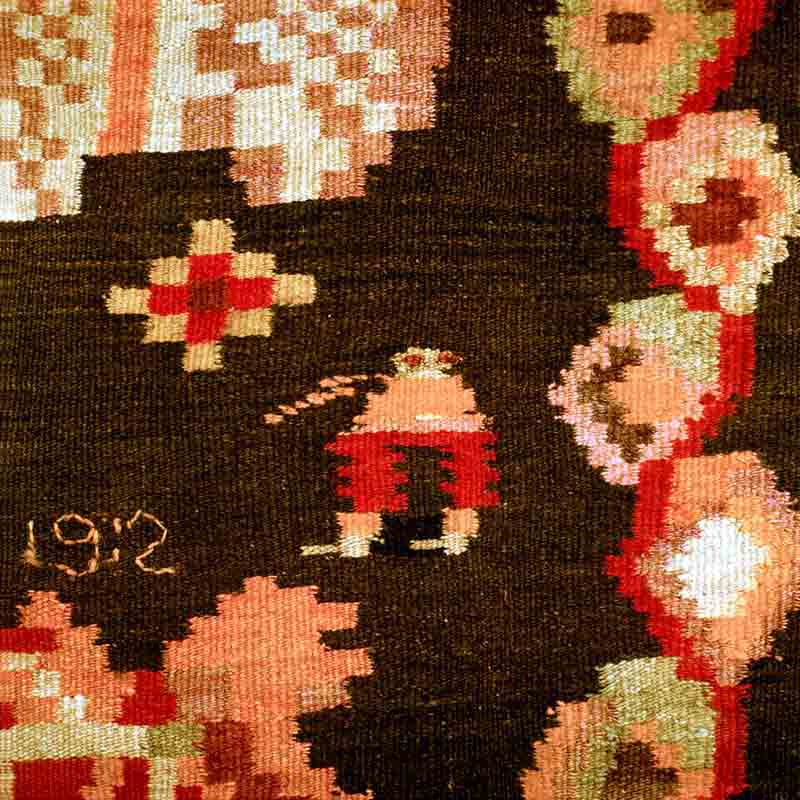
Traditional wall-carpet craftsmanship in Romania and the Republic of Moldova joined UNESCO’s Representative List in 2016. The carpets were never only decoration: they insulated cold walls, formed part of a bride’s dowry, and at funerals stood for the passage of the soul to the hereafter. Certain patterns showed where the weaver came from, so an old carpet can be read as a regional signature. In villages girls learned the craft from a mother or grandmother, while in cities craft centres, associations, colleges and museums teach it.
The work is slow. Moldova’s tourism board notes that a carpet usually needs at least four women working together, and that a large one can take a year or two to finish. Today the pieces are valued mainly as artworks for homes and public galleries, and they are brought out at city festivals and ceremonies — the Frumos Covor Basarabean festival is built around them. UNESCO calls the craft an expression of creativity, an identity marker and a way of uniting people of different ages and backgrounds.
Doina, lăutari and modern exports
The doina is the heart of the region’s older song tradition: a free-rhythm, heavily ornamented, improvised melody sung solo, with or without instruments, at home or outdoors, at work or at a wake. UNESCO inscribed it in 2009 on a Romanian nomination, describing it as a lyrical, solemn chant and a cathartic outlet that strengthens solidarity. The same listing warns that transmission between generations has broken down, and that only about fifteen practitioners representing the different regional variants had been identified.
Dance music belongs to the lăutari, professional Romani musicians whose clan adopted the name in the late 18th century. They play in loosely organised bands called tarafuri, often made up of the men of one extended family and led by a soloist known as the primaș. The violin and the nai panpipe were their old instruments; the accordion dominates the modern sound, and their music sets the structure of a village wedding. The best-known modern export is Zdob și Zdub, a folk-punk band from Chișinău active since 1994, which represented Moldova at Eurovision in 2005, 2011 and 2022.
The embroidered blouse
In 2022 UNESCO inscribed the art of the traditional blouse with embroidery on the shoulder — the altiță — as an element of cultural identity in Romania and the Republic of Moldova. The blouse, called ia, is white and made of natural fibres: flax, cotton, hemp or floss silk. Its complex stitch combines horizontal, vertical and diagonal seams to build a specific pattern and texture, and the garment is made entirely by hand. Motifs range from geometric and stylised registers to organic shapes, in colours from sombre to vivid.
Style and technique vary by region, by the age of the wearer and by the skill of the woman making it. The craftsmanship is exclusively female and generally passed on within families, although organisations, museums and schools now run camps and courses. Moldova’s tourism board notes that the ia was reserved for holidays rather than everyday wear, that 24 June is marked as folk wear day, and that the IA Mania festival celebrates the same garment. Interest in sewing them is rising again as a way of affirming national identity.
Pottery, weaving and craft fairs
Beyond the UNESCO listings the everyday crafts continue: pottery, leather working, weaving with osier or corn husks, carpet weaving, embroidery and crochet. Ceramics and weaving are still practised in rural areas, and visitors can watch or take part. At the Ceramica Triboi centre you can join a class with the potter Zaharia, who learned the trade thirty years ago, and his son Adrian, who works traditional forms into more minimalist shapes; Vasilii Gonciari keeps a large collection of ceramic forms at his workshop in Hoginești, and Eugenia Burlacenco began learning the craft at the age of five.
Wine turns up in the clay as well as the cellar — potters shape wine-themed figurines, presses, jugs and mugs. Festivals gather the makers in one place: IA Mania for the blouse, Frumos Covor Basarabean for carpets and iProsop for embroidered towels. Song and dance run on the same circuit, with the sârba and the hora as the standard dances, and the old ballads Miorița and Meșterul Manole at the centre of the folklore. The national folk choir, Doina, carries the same repertoire on stage.