Food and Wine
Moldovan cooking starts with cornmeal, brined sheep’s cheese and some of Europe’s most fertile black soil, and it usually ends with a glass of something grown a few kilometres from the table.
Mămăligă and the everyday table
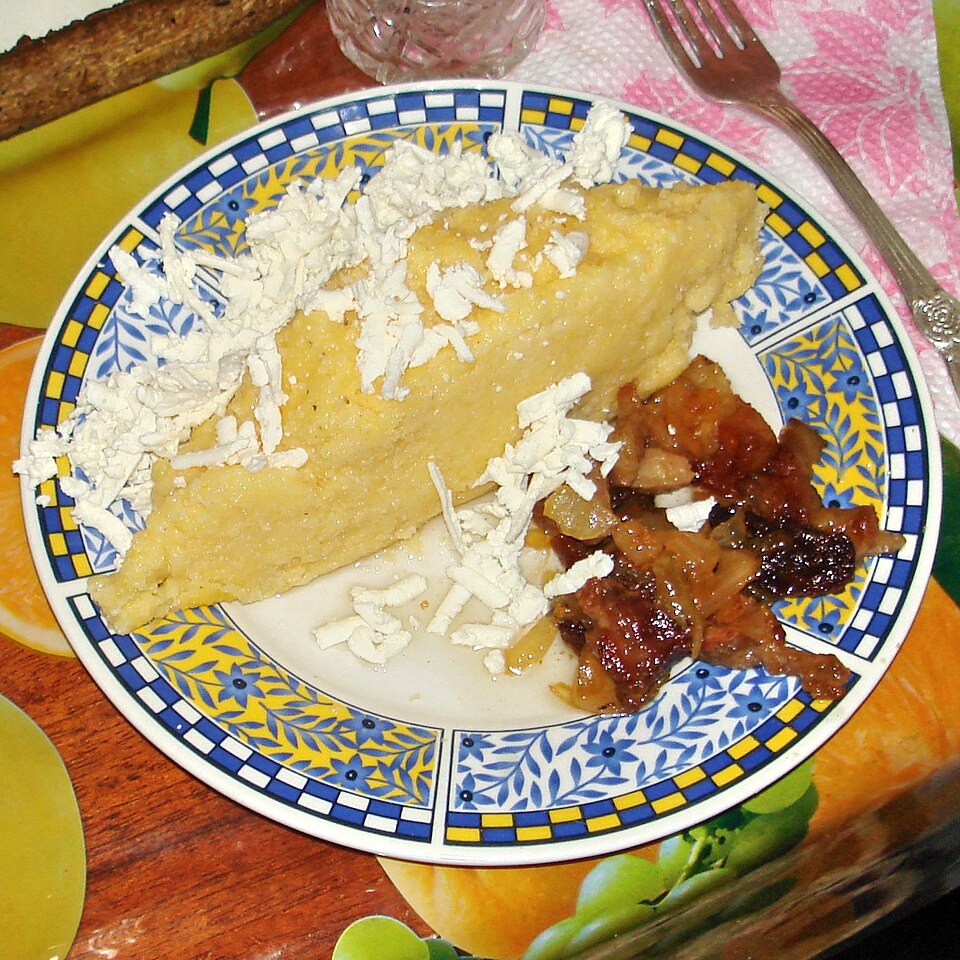
The best-known Moldovan dish is mămăligă, a cornmeal mush closer to polenta than to bread. It is served as an accompaniment to stews and meat dishes, or on its own garnished with cottage cheese, sour cream or pork rind. Alongside it come regional staples such as brânză, a brined cheese, and friptură, a lamb or goat stew. Moldova’s chernozem black soil supplies the rest: tomatoes, peppers, aubergine, cabbage, beans, onions, garlic and leeks, eaten in salads and sauces or baked, steamed, salted, marinated and pickled as murături.
Soup carries the meal. The borș or ciorbă family covers a wide range of meat, vegetable and fish soups with a characteristic sour taste, soured either with bran-based borș or with lemon juice; zeamă, a chicken soup with meat, is commonly served. Meat is traditionally an appetiser or first course rather than the finish — roasted and grilled pork, steamed lamb, and beef meatballs known as pârjoale and chiftele. Colțunași, a local relative of pierogi, are filled with fresh white cheese, meat or cherries. Local wine accompanies most meals.
Plăcinte and the holiday table
Plăcinta is the pastry Moldovans eat at any hour of the day: a thin, small, round or square case, filled and then baked or fried. Fillings run from sheep or cow cheese such as telemea, or soft cheese with dill and raisins, to potato, cabbage and apple, and there is even a pancake-thin version called plăcintă clătită. The habit of baking one large sheet and cutting it into squares to sell goes back to the Roman placenta, and Romanian and Moldovan bakers still work that way.
Holidays bring out a longer list of baked goods on the same table: cozonac, pască, brânzoaice (also called poale-n brâu), sfințișori, papanași, colaci, plăcinte and cornulețe, filled with cheese, fruit, vegetables or walnuts. The savoury centrepiece is sarmale, cabbage rolls stuffed with minced meat, usually eaten with mămăligă and sauerkraut. Minority kitchens add their own dishes — mangea, chicken in sauce, among the Bessarabian Bulgarians in the south, the heavily seasoned mutton soup shorpa among the Gagauz, borscht in Ukrainian villages and pelmeni in Russian communities.
A country under vine
Wine is not a sideline here. Moldova’s national tourism portal claims the country has “the highest percentage of vineyards to total agricultural land of any country in the world”, with more than 128,000 hectares planted. Published figures put the vineyard area at 148,500 hectares, of which 107,800 are used for commercial production; the remaining 40,700 hectares are the small plots around village houses, where families make wine from recipes and grape strains handed down over generations. Grape seed imprints found near Vărvăreuca date cultivation here to about 2800 BC.
Output runs to around two million hectolitres a year, which made Moldova the eleventh largest wine-producing country in Europe as of 2018. Most of it leaves the country: in 2022 wine was sent to 75 countries, with 60 per cent of production going to European Union markets. Three historical regions — Valul lui Traian in the south-west, Ștefan Vodă in the south-east and Codru in the centre — are designated for wines with a protected geographical indication. Alongside wine, Moldova distils divin, its national brandy, following classic cognac methods.
Cricova and Mileștii Mici
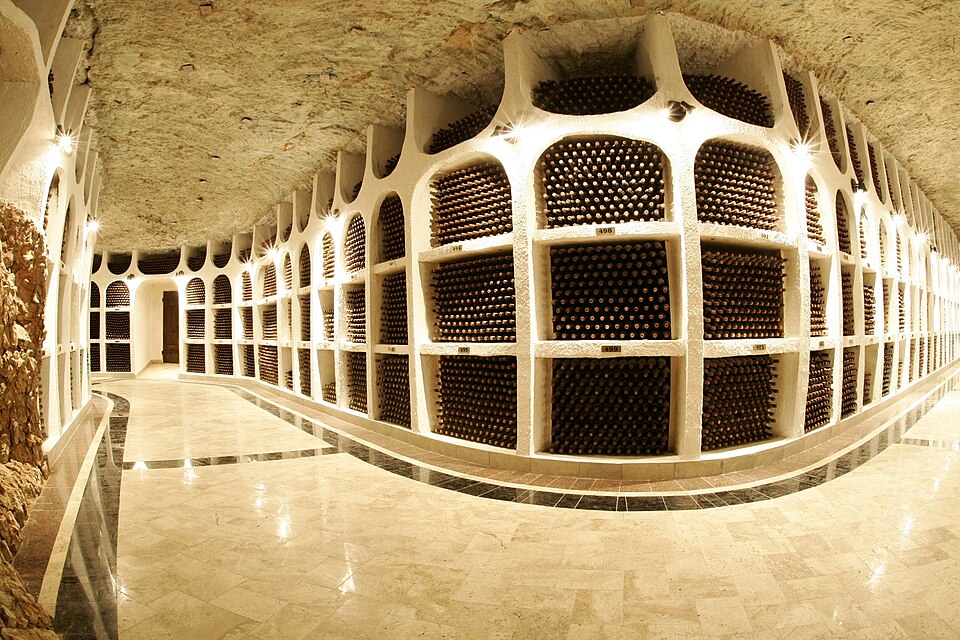
Both of Moldova’s famous cellars began as limestone workings. Stone has been dug beneath Cricova, just north of Chișinău, since the 15th century, and the tunnels were converted into an underground wine emporium in the 1950s. About 120 kilometres of labyrinthine roadway now run below the surface, reaching 100 metres down and held at roughly 12 °C all year, with the streets named after the wines stored along them. The collection amounts to well over a million bottles, and the oldest wine dates from 1902.
Mileștii Mici, south of the capital, goes further still. Its cellars were listed in the Guinness World Records 2007 Yearbook as holding the largest wine collection in the world, counted then at two million bottles. The gallery network is far longer than the part currently in service. Both sites are working wineries rather than museums, and both are toured by vehicle along the underground streets. Cricova is also the source of Moldova’s best-known sparkling wines, made from Chardonnay, Pinot blanc and other European varieties.
Indigenous grapes and National Wine Day
International varieties such as Cabernet Sauvignon, Sauvignon and Muscat are widely planted, but the local grapes are the reason to pay attention: Fetească albă and Fetească regală for whites, Fetească neagră and Rară neagră for reds. Rară neagră is down to roughly 170 hectares, mostly in the Purcari region, and it is the grape behind Negru de Purcari — it made the reputation of Purcari wines in the 18th century, before Cabernet Sauvignon was introduced. Moldova also produces red sparkling wines, a style originally introduced here.
National Wine Day falls on the first weekend of October in Chișinău and is described as the largest wine festival in Eastern Europe, drawing on the work of more than 150 wineries. Outside the festival, each designated region has its own signposted route: Codru, Valul lui Traian, Ștefan Vodă, and Divin for the brandy. The Artisanal Wines Route runs about 215 kilometres, up to four hours’ driving, as a one-day loop from Chișinău linking small family producers, oven-baked food and village hospitality.