Travel and Places
Moldova is small enough to cross in a few hours, which means a cave monastery above a river bend, a circular fortress on the Dniester and an underground wine city can all fit into the same short trip.
Chișinău
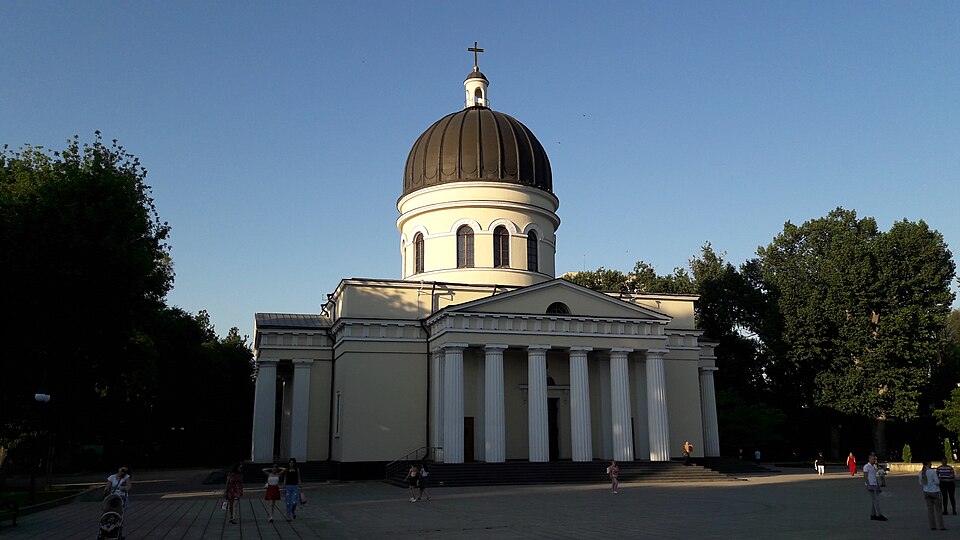
Chișinău was founded in 1436 as a monastery village in the Principality of Moldavia. The 2024 census counted over 567,000 people in the city proper and over 720,000 in the wider municipality, making it the country’s main industrial, commercial and transport hub. Its landmark is the Cathedral of the Nativity, built in the 1830s to a neoclassical design by the architect Abram Melnikov, with six Doric columns marking the entrance, and dedicated in October 1836. Its free-standing bell tower was destroyed by local Communists in 1962 and rebuilt in 1997.
The cathedral stands in a central park behind the Triumphal Arch, completed in 1840 to plans by Luca Zaushkevich, and faces Great National Assembly Square. Next to it, Ștefan cel Mare Central Park is anchored by Alexandru Plămădeală’s 1927 statue of Stephen the Great, which Moldova’s tourism board describes as the meeting point for lovers as well as for protesters. The city is unusually green, with trees along its streets and boulevards and Valea Morilor park near the centre; much of the older streetscape is the work of the architect Alexandru Bernardazzi.
Orheiul Vechi
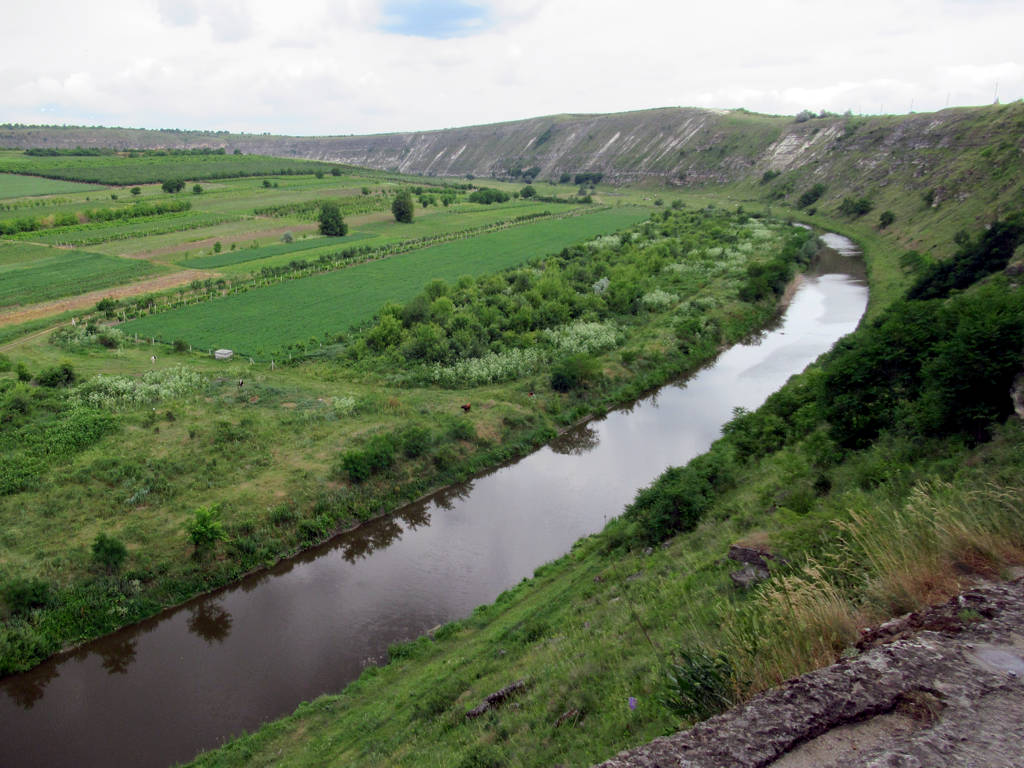
Orheiul Vechi, about 60 kilometres north-east of Chișinău, is the country’s best-known historical and archaeological complex: limestone cliffs eroded by the Răut river, with ruins layered into and around them. Excavations have found traces of settlement from the Palaeolithic through the Iron Age, along with Trypillian remains, the earthen and wooden fortifications of a Geto-Dacian fortress from the 6th–1st centuries BC, the 14th-century Golden Horde town of Shehr al-Jedid, and a Moldavian fort in use from the 14th to the 16th century.
The cave monastery cut into the cliff dates from around the 14th century and is still in use: the caves work as chapels and hold an array of historical artefacts. Orheiul Vechi forms the core of Orhei National Park, established in 2013. The Răut below is used for kayaking trips promoted by the national tourism portal, and the site is close enough to the capital to visit and return in a day.
Soroca Fortress
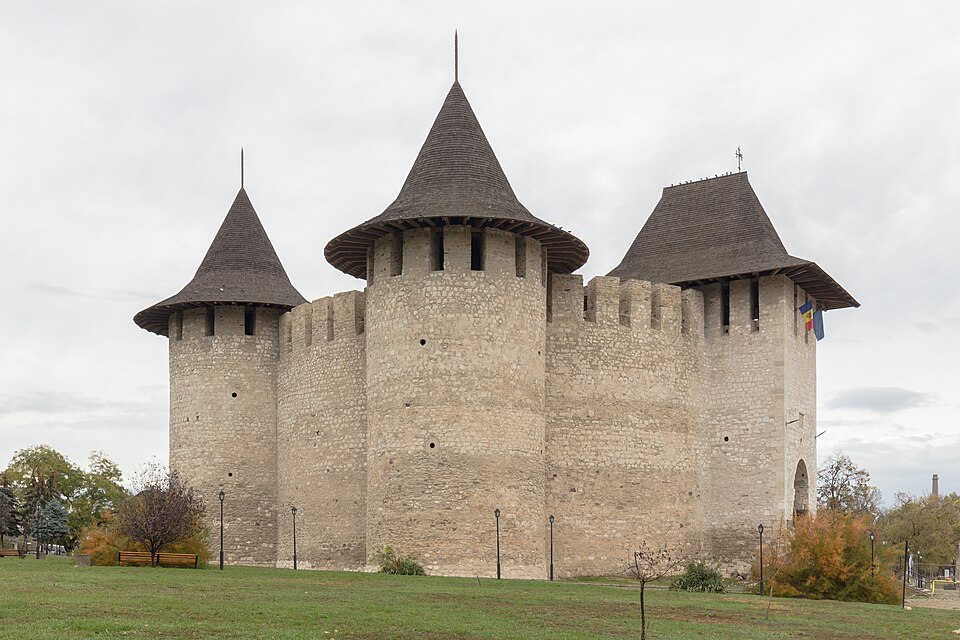
Soroca sits on the Dniester in the north of the country, and its fortress guarded a ford across the river — one link in a chain of four forts along that line. Stephen the Great put up the first wooden fort in 1499. Between 1543 and 1546, under Petru Rareș, it was rebuilt in stone as a perfect circle roughly 30 metres in diameter, with five bastions set at equal distances. The walls were built curved rather than straight so that projectiles would glance off them, and the four outer towers follow the same logic. The fort has since been renovated.
Căpriana and Curchi
Căpriana, about 40 kilometres north-west of Chișinău in the wooded Codrii Lăpușnei of Strășeni district, first appears in a document of 1429 that granted it royal monastery status under Alexander the Good. Its stone Church of the Dormition was built between 1491 and 1496 under Stephen the Great and is the oldest church still standing in Moldova; Petru Rareș rebuilt much of the complex between 1542 and 1545. Metropolitan Gavril Bănulescu-Bodoni is buried inside, and later churches dedicated to St Nicholas and St George stand alongside it.
Curchi, roughly 14 kilometres south-west of the town of Orhei, is a different kind of place — a baroque monastery founded between 1773 and 1775, though some date its foundation to 1868, when the stone church was converted. Its cathedral, completed in 1872, carries a 57-metre dome and was modelled on St Andrew’s Church in Kyiv. The Soviet state turned the monastery into a psychiatric hospital, which operated from 1959 to 1999; the buildings reopened as a monastery in 2005 after restoration.
Getting around and the wine routes
Almost everything worth seeing works as a day trip from Chișinău. Each of Moldova’s designated wine regions has its own route — Codru, Valul lui Traian, Ștefan Vodă, and Divin for the brandy — and the Artisanal Wines Route covers about 215 kilometres, up to four hours’ driving, through villages including Costești, Pereni, Ciorești, Micleușeni, Sadova, Vorniceni and Cojușna. It is designed as a one-day loop past small family wineries, with optional stops for a pottery class at Ceramica Triboi and a honey tasting at Conacul Mierii.
Moldova received 2.85 million visitors in 2015, most of them from Romania, Ukraine and Russia, so crowds are rarely the problem. Romanian and Russian are the mainstays of everyday communication, with English increasingly spoken by younger residents, and the tourism board notes good wi-fi in almost every hotel, restaurant, café and bar. If your dates are flexible, the first weekend of October puts National Wine Day in the centre of Chișinău, and February brings a running race through the cellars at Mileștii Mici.